Can a President Run Again After Serving Two Terms
Some leaders of countries seem to have an indefinite catamenia of rule. In Russia, Putin has been in charge for nearly ten years. Chancellor Angela Merkel of Germany has been in power for 5143 days at the fourth dimension of writing.
In the United States, there are Ramble laws to stop one person from belongings too much power for likewise long.

So, how long can yous be president for and when did this dominion come into play?
How Long Can A President Serve?
Under normal circumstances, a president can serve 8 years. The 8 years is split into two terms of 4 years each.
The current constitution with amendments states that a president can serve a four-year term from the inauguration and seek re-election. If they are successful in gaining a second term, they are not allowed to run for office again after finishing the second term.
Instead, the party must observe a new nominee and campaign for them with the endorsement of the current leader.
Exceptions to the 2 Terms Rule
Notwithstanding, there are some cases where this isn't quite so straightforward.
Some presidents don't get-go their journey as President-Elect but instead enter office mid-term. Also, terms don't have to exist consecutive and this two-term rule wasn't e'er in force.
How Did Franklin D. Roosevelt Serve More Than 2 Terms?
We are used to presidents serving for 4 years, seeking re-election, and so passing the baton on at the end of a second term. Nonetheless, this hasn't always been the case.
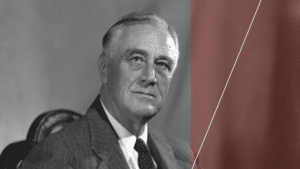
Political and social changes tended to allow for a natural line of succession every bit different parties took power and new faces became the best candidates. FDR was the exception to the dominion.
Franklin D. Roosevelt served four terms every bit president
Franklin D. Roosevelt was elected into office iv times, although he only served a fraction of the fourth earlier his expiry. His popularity and the success of his policies throughout his presidency meant that he could easily seek re-election with the support of the party and voters.
His full presidency ran from March 4, 1933, to April 12, 1945, which saw the nation by the Depression, through the New Deal, and into the Second Earth War.
In total, that meant three full terms and one partial term. He was elected for a fourth but died later just ii months and 23 days into his fourth term.
Did Whatsoever Other President Endeavor For A Third Term?
The dominion nigh limiting the president to two terms came into the constitution so belatedly, you would expect to see more three-term presidencies earlier on. But, this wasn't the case and Roosevelt was the simply one to do so. This is because of a combination of factors regarding the health and popularity of two-term presidents.
At that place was likewise an unwritten agreement to stick to two terms. The idea of a two-term limit had been effectually since the Constitutional Convention and both George Washington and Thomas Jefferson were said to be in favor. James Madison, James Monroe, and Andrew Jackson all decided to continue with the principle.
This wasn't the case for everyone though, as there were presidents that wanted to continue. Ulysses S. Grant was one of them and fabricated different attempts to practise so. At that place was an initial plan to stay on and try for re-election for a consecutive 3rd term in 1876 only negative stance persuaded him not to. Withal, he put himself upwardly for nomination in 1880 and lost to James Garfield.
What changed to limit the president to 2 terms?
In order to stop this sort of extreme presidential run from happening again after Roosevelt, the state needed an amendment to the constitution. The 22nd Amendment states that
"no person shall be elected to the office of the President more than twice"
This came from House Joint Resolution 27 following the expiry of Roosevelt. It took iii years, 343 days for the ratification process to reach completion on February 27, 1951.

There was a vital caveat to this amendment that affected the presidency of current president Harry S. Truman. Because he was the incumbent president and the amendment was to utilize to future presidents, he could have served more than two terms. Still, this important grandfather clause ended up being unnecessary. Truman could take sought re-election in 1952 even though he served ane full term and nearly of Roosevelt's quaternary. But, his approving rating of 27% was enough for him to stride aside.
Tin A President Serve For More viii Years?
This is where things become a little more complicated. A presidential term is fixed to iv years with the Inauguration taking place on the same engagement, Jan 20th. This means that ii total presidential terms add together up to viii years and no more. It is as well interesting to measure the length of a president's fourth dimension in office past day. All two-term presidents served for 2,922 days autonomously from Washington's 2,865.
Washington took power earlier information technology was decided to have all terms begin on the 4th of March. This subsequently switched to the 20th of January. However, there is a potential situation where a president could serve for 10 years. It all depends on how they come to power.
The 25th Amendment is a great tool to protect the office of the president and ensure that the right person is in charge at all times. In that location are plenty of examples of presidents that didn't run across the end of their term. Impeachment, decease by natural causes, and assassination all meant that the nation could take been without a leader until the next election if there wasn't someone to fill in. This role typically falls to the vice president, unless at that place is good reason to go further down the line of succession.
A vice president may be sworn-in directly after the death or removal of a president from office and and then seek to exist nominated as the political party candidate at the next election.
The 2nd clause of the 22nd amendment states the post-obit:
"no person who has held the office of President, or acted as President, for more than than two years of a term to which some other person was elected President shall be elected to the office of the President more than once"
Therefore, every bit long equally that original partial term didn't exceed two years, presidents are then costless to stand over again after a successful full term. The opportunity is there for a 10-twelvemonth term. All the same, this has never happened. There are a few cases of presidents that took over mid-term and went on to exist elected themselves but none went whatsoever further for various reasons.
Lyndon B. Johnson'southward Potential For A 9-Year Term.
The all-time example of a modern-day president to come close to this accomplishment is Lyndon B. Johnson. Johnson originally came to ability from his part as vice president. Kennedy was assassinated 1 year, 1 month, and 29 days into his second term and Johnson took over immediately.
After completing this term, Johnson was re-elected past a landslide in 1964. The dominion on the length of the fractional term meant he was allowed to run again in 1968. This was considered, but Johnson ultimately pulled out due to a combination of health and political reasons. At that place were fears almost his heart and his handling of the Vietnam State of war.
Do Presidential Terms Take To Be Consecutive?
No rule states that a president must take on their second term in office straight after their beginning. However, it is rare to run across not-consecutive terms in office. For a beginning, many of the presidents of the period of the late 20th and early on 21st century were successful in their bid for direct re-election.
Before Trump became unsuccessful in his endeavor for re-ballot, three presidents were able to achieve 2 consecutive terms. Neb Clinton won the election of 1992 and stayed until 2000. Here power switched parties with Bush Jr. taking the presidency. In 2008 Bush-league had to stride down and his successor fought for election confronting Barack Obama. Obama stayed in power until 2016 when Trump won his ballot.
Grover Cleveland'due south Not-Sequent Terms.
Presidents that lose their re-election bid are perfectly entitled to try again afterwards on in life. Those 8 years in power could be pretty far autonomously, as long equally the same person doesn't stay in office for more than those ii terms. In that location accept been plenty of attempts to become back into power at a after date, but only one was successful.
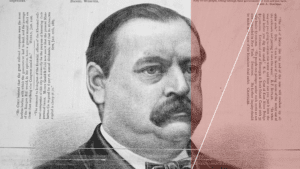
Grover Cleveland came to ability on March 4, 1885, and served his full four-year term until 1889. He had lost the bid for re-election in the 1888 election. But, that didn't end him from trying over again in the next race. Not only did he achieve the party nomination but the public voted him back in during the 1892 election. He would then serve his 2nd full term – as the 24th President of the United States – from March four, 1893, to March 4, 1897.
Presidents That Tried For Non-Consecutive Terms And Failed.
Information technology is a tough process to win back the trust of a political party and supporters afterwards i failed attempt, specially if a political landscape evolves beyond the ideas that got you into power. Some former presidents have tried to get back to their political party and return to the office, while others evolved in a different direction.
Martin Van Buren'south Attempt To Regain The Democratic Nomination.
Van Buren was 1 of a small number of presidents that did non retire gracefully and leave politics to younger men. He was upwardly for re-election in 1840 but lost, leading him to retire. Dissatisfied with the event, he came dorsum to political life in 1844 to fight for the nomination.
He came close but lost to Polk. By the time the 1848 election came effectually, there was growing tension between Van Buren and the Democratic Party, and his chances of nomination were fifty-fifty slimmer. Then, he decided to run equally a candidate for the Free Soil Party. This got him on the election again for the offset time in eight years but didn't earn him many votes.
Teddy Roosevelt's Attempt To Remove Taft From Power.
One of the virtually interesting cases of a president trying their luck numerous times is that of Teddy Roosevelt. His initial run consisted of a partial term of three years, 5 months, and 18 days and so ane full term following his election.
At this bespeak, Roosevelt passed the torch to Taft and declined to run for a second full term. At this point in history, information technology would accept been fine according to the constitution for him to go on. The trouble was that he regretted his endorsement after Taft'southward ballot in 1908, which led him to challenge Taft for the nomination in 1912.
Taft retained the Republican nomination, so Roosevelt tried a different approach to oust him from power. He formed the Bull Moose Political party (officially known equally the Progressive Party) to challenge as a third-party contained. The vote was dissever leading the Democrat Woodrow Wilson won the race.
Could We See Non-Consecutive Presidential Terms Again?
One of the curiosities about the rules for running for president is that in that location is a lower age limit of 35 but no upper limit. Therefore, in that location is nothing to stop former single-term presidents from running again 4 or even viii years later on a failed bid. The flip side to that is that you now have presidents that are already quite one-time when they take office for the first time. This limits the chances of any interesting campaigns for not-sequent terms in the futurity.
At the moment, we have two living former presidents that served a single term and could theoretically come up back. The odds of Jimmy Carter getting back into politics are incredibly low given that he is 97. In that location is e'er speculation most Donald Trump trying once more in 2024, at which point he would be 77. Then there is Joe Biden, who is already 79 in his first year in office.
Two-term Presidencies Are Here To Stay.
The 2-term rule may be a little more complex than it outset appears, but it is an essential office of presidential rule in the United States. Even before the ratification of the 22nd Subpoena, there was that unwritten agreement that ii terms were more enough. This is unlikely to ever change.
chavezpatents1957.blogspot.com
Source: https://constitutionus.com/presidents/how-many-terms-can-a-president-serve/
0 Response to "Can a President Run Again After Serving Two Terms"
Post a Comment