Marlon Brando Sent Someone to Oscars to Read a Statement for Him
S acheen Littlefeather begins past announcing that this will be one of her last interviews: "I'thou very, very ill. I have metastasised breast cancer – terminal – to my correct lung. And I've been on chemotherapy for quite some time, and daily antibiotics. As a effect, my retention is not as good as it used to be … I'm very tired all the time because cancer is a full-fourth dimension chore: the CT scans, MRIs, laboratory blood work, medical visits, chemotherapy, infectious disease control doctors, etc, etc. If you're lazy, you lot demand non utilize for cancer."
For the side by side couple of hours, speaking over Zoom from her home in northern California, as she trips down memory lane her solemn demeanour gives manner to chattiness and laughter. At 74, she has lived a total, eventful life, though she will be for ever remembered for an event that took up footling more than one infinitesimal of it, on the night of 27 March 1973. This was when she took the stage at the 45th Academy Awards to speak on behalf of Marlon Brando, who had been awarded best thespian for his functioning in The Godfather. It is all the same a striking scene to spotter. Amid the gaudy 70s evening article of clothing, 26-year-old Littlefeather'southward tasselled buckskin dress, moccasins, long, direct black hair and handsome confront fix in an expression of almost sorrowful composure, make a jarring contrast.
When the presenter, Roger Moore, attempts to hand Littlefeather Brando's Oscar she holds out her paw as if to button information technology away. She explains that Brando cannot accept the award because of "the treatment of American Indians today by the film industry". The crowd interrupts her, half-applauding, half-booing. "Excuse me," she says calmly, then continues: "And on idiot box and moving-picture show reruns, and also with recent happenings at Wounded Knee." At the time, Wounded Knee joint, in Southward Dakota, was the site of a month-long standoff between Native American activists and US authorities, sparked by the murder of a Lakota man. Littlefeather ends her spoken language begging that "in the future, our hearts and our understandings will meet with dear and generosity".
At the time, nobody knew what to make of information technology. Non the audition, the press or the 85 million people watching on television (this was the kickoff year the Oscars were broadcast internationally via satellite). Was it a prank? A surrealist functioning piece? Littlefeather was rumoured to be a hired thespian, a Mexican impostor, a stripper. "It was not a functioning, it was a real presentation," she says. "I think that's what took people by surprise: that it was so real. Information technology really touches people's hearts to this day."
It was hastily planned, says Littlefeather. Half an 60 minutes earlier her speech, she had been at Brando's house on Mulholland Drive waiting for him to finish typing an eight-page speech. She arrived at the anniversary with Brando's assistant, just minutes before best actor was announced. Howard Koch, the producer of the University Awards evidence, immediately informed her she could non read it – and she would be removed from the phase after sixty seconds. "And then it all happened so fast when information technology was announced that he had won. I had promised Marlon that I would not bear on that statue if he won. And I had promised Koch that I would not go over 60 seconds. So there were two promises I had to go along." Equally a result, she improvised her spoken language.
Still valid Brando's charge of the fashion Hollywood stereotyped Native Americans, it did not go down well that night. John Wayne, series slaughterer of Native Americans on-screen and self-professed white supremacist off information technology, just happened to be in the wings during Littlefeather's speech. "During my presentation, he was coming towards me to forcibly have me off the stage, and he had to be restrained by six security men to prevent him from doing so." Presenting all-time picture presently after (also for The Godfather), Clint Eastwood quipped: "I don't know if I should present this award on behalf of all the cowboys shot in all the John Ford westerns over the years." When Littlefeather got backstage, she says, in that location were people making stereotypical Native American war cries at her and miming chopping with a tomahawk. After talking to the press, she went directly dorsum to Brando's business firm where they sat together and watched the reactions to the result on television receiver.
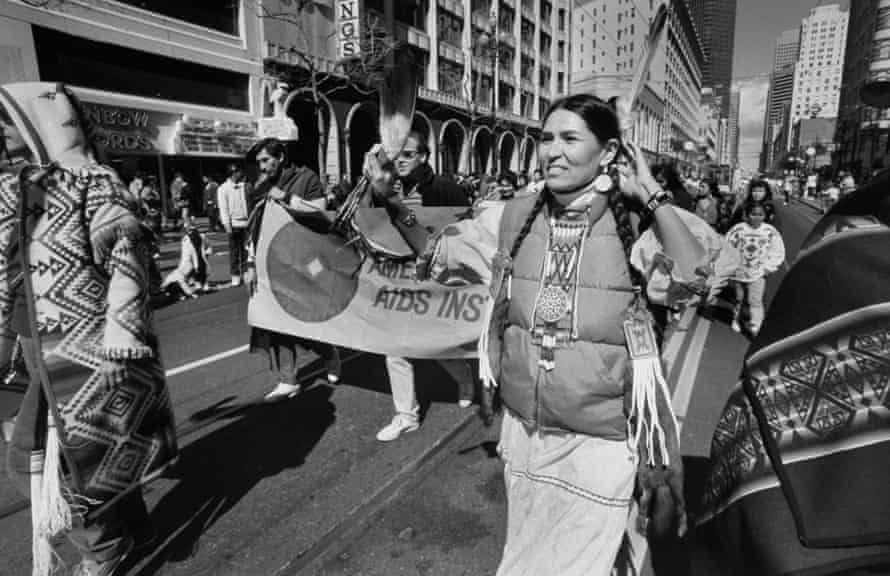
Just Littlefeather is proud of the trail she blazed. She was the first woman of colour, and the outset ethnic woman, to use the Academy Awards platform to make a political statement. Today they are almost expected, but in 1973 it was radical. "I didn't apply my fist [she clenches her fist]. I didn't apply swearwords. I didn't raise my voice. But I prayed that my ancestors would help me. I went up in that location similar a warrior woman. I went upward in that location with the grace and the beauty and the courage and the humility of my people. I spoke from my center."
Littlefeather's life upward to that indicate had been difficult. Her father was Native American, a mix of Apache and Yaqui, and her mother was white. They met in Arizona – where mixed-race couples were still illegal – so moved to Salinas, California, working as saddle-makers and leather-stampers. "My biological parents were both mentally sick and unable to enhance me," she says. "I was a child who was abused and neglected. I was taken away from them at age iii, suffering from tuberculosis of the lungs. I lived in an oxygen tent at the hospital, which kept me live." She was raised by her maternal grandparents, but saw her parents regularly. She recalls a time as a pocket-size child when she interrupted her male parent beating her female parent – by hitting him with a broom. "I think that's when I actually became an activist." Her begetter chased later on her. "I escaped through a doorway and I ran with all my might down the road. And he got in the pickup truck, and he tried to run me over. There was a grove of trees. And it was near dark. I ran upwards a tree, and he couldn't detect me. I stayed upwards in the tree and I cried myself to sleep."
Littlefeather was between ii worlds. Since the tardily 19th century, there had been a concerted project in the U.s.a. to "brand Indian people white", she explains, spearheaded by federal government and Christian schools for Native American children. "They wanted to make us something else. And this leads us into terrible pain, into suicide, into alcoholism, into jails." She did not fit in at the white, Catholic school her grandparents sent her to. "At that place was a lot of racism. I was called the N-word." When she was 12, she and her grandad visited the celebrated Roman Cosmic church Carmel Mission, where she was horrified to see the bones of a Native American person on display in the museum. "I said: 'This is wrong. This is not an object; this is a man being.' So I went to the priest and I told him God would never corroborate of this, and he called me heretic. I had no idea what that was." In her teens, Littlefeather had a breakdown and was hospitalised for a yr. She attempted suicide. "I was then confused most my own identity, and I was suffering," she says. "I could non tell the departure between me and my pain."
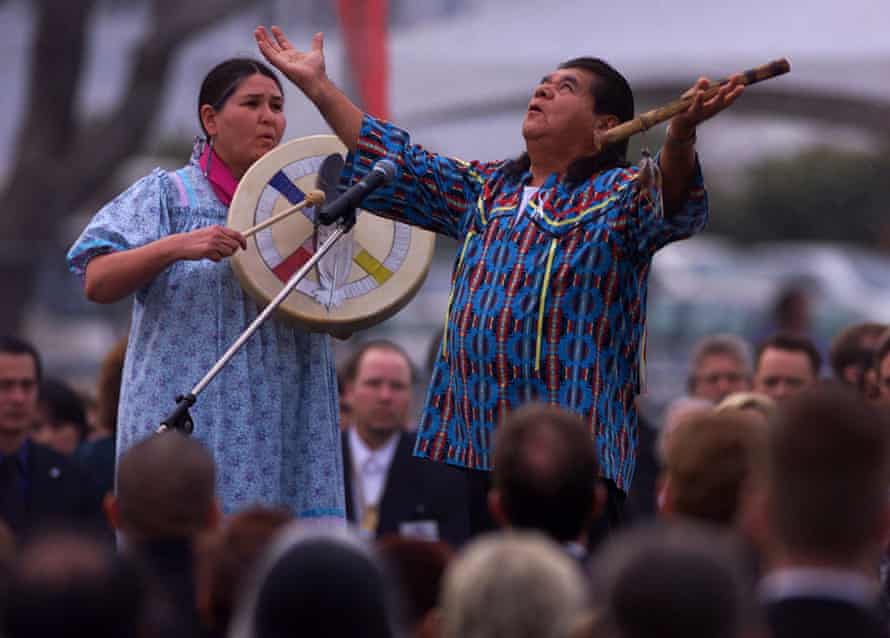
Fortunately, in the late 1960s and early 70s Native Americans were beginning to reclaim their identities and reassert their rights. Later her male parent died, when she was 17, Littlefeather began visiting reservations in Arizona, New Mexico and California. She visited Alcatraz when it was occupied by Native American activists in the early 1970s. She travelled around the country, betwixt campsite-outs and pow-wows, learning traditions and dances, making outfits. "I really had a quantum, with other urban Indian people, getting back into our traditions, our heritage. The old people who came from dissimilar reservations taught us young people how to be Indian over again. It was wonderful."
By her early on 20s Littlefeather was working every bit public service director at a San Francisco radio station, and caput of the local affirmative action committee for Native Americans, studying representation in film, goggle box and sports (they successfully campaigned for Stanford University to remove their offensive "Indian" sports squad symbol). I of her neighbours was Francis Ford Coppola. "I used to hike the hills of San Francisco every mean solar day," she says. "He'd exist sitting on his porch, drinking iced tea." She got to know him to say howdy to. At the time, many celebrities were expressing interest in Native American diplomacy, including Jane Fonda, Anthony Quinn and Burt Lancaster. Sometimes it was sincere, at others more than cocky-interested, she says. Then, when she heard Marlon Brando speaking about Native American rights, "I wanted to know if he was for real". She wrote a letter to him and, walking by Coppola's house one day, said: "Hey! You directed Marlon Brando in The Godfather." She asked him for Brando'due south address. Eventually, Coppola gave information technology to her.
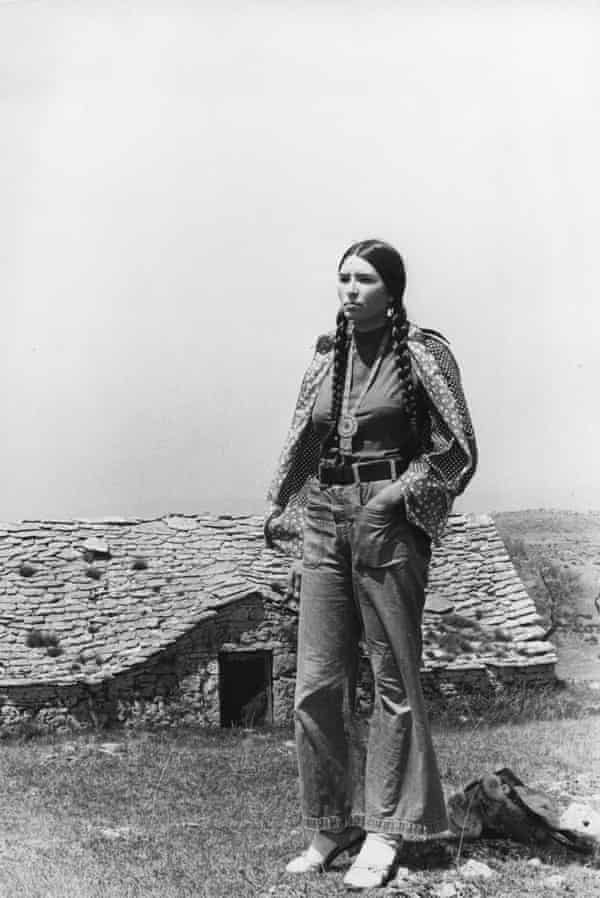
She heard nothing for months, but 1 dark a homo phoned her at the radio station. "He said: 'I bet you lot don't know who this is.' And I said: 'Certain I do.' And he said: 'Well, who is it?' I said: 'Information technology'south Marlon Brando. It sure as hell took you lot long plenty to call. Yous beat out "Indian time" all to hell.' And we started to laugh equally if we'd known each other for ever."
They talked for near an hour, she says, and then chosen each other regularly. Before long he was inviting her to visit. She stayed with him several times. They became good friends, but were never lovers or romantically involved. "No, no, he was far too erstwhile for me. He was my mother's age, for God's sake! He was extremely intelligent, and always entertaining. He had a great humor. He would put on tons of different voices. Nosotros used to accept a great fourth dimension, laughing till tears were coming out of our optics."
The Brando household was a busy and often heated place – with children, ex-wives and girlfriends. Brando sent her and his girlfriend Jill Banner to go and see his latest motion picture, Last Tango in Paris – Bernardo Bertolucci's controversially graphic erotic drama (which would earn Brando another Oscar nomination). Littlefeather was not shocked, she says. "I merely thought that it was about a human being who had a very hard relationship with women. I idea about Marlon in his early days with his mother. It was every bit though his life was being played out in that film." Brando, likewise, had had difficult parents: his father was disapproving and unloving; his mother an alcoholic. "When he was immature, they didn't accept therapy. Maybe that was why he was such a great actor – because he worked information technology out in his interim. He was able to share those real emotions with an audience. And maybe that was the beloved-hate relationship that he had with acting."
Littlefeather's Oscar oral communication drew international attention to Wounded Knee joint, where the US authorities had essentially imposed a media blackout. It was a key moment in the struggle for Native American rights and may well have saved lives, she suggests. It did little for her ain career, however. She had had a few minor roles in movies, including Freebie and the Edible bean and The Trial of Billy Jack. After the Oscars, she believes she was blacklisted by Hollywood. "I couldn't get a job to salvage my life. I knew that J Edgar Hoover had gone around and told people in the industry not to hire me, considering he would shut their talkshow or their product down. I got the word from people in the industry that that would happen to them." She is not sure it helped Brando's career, either. "I was a hotbed of controversy. And for any histrion, I don't know how condom that is for them, box role-wise." They stayed in contact for a fiddling while, but their lives naturally went carve up ways. "Nosotros had our time together. We made history together."
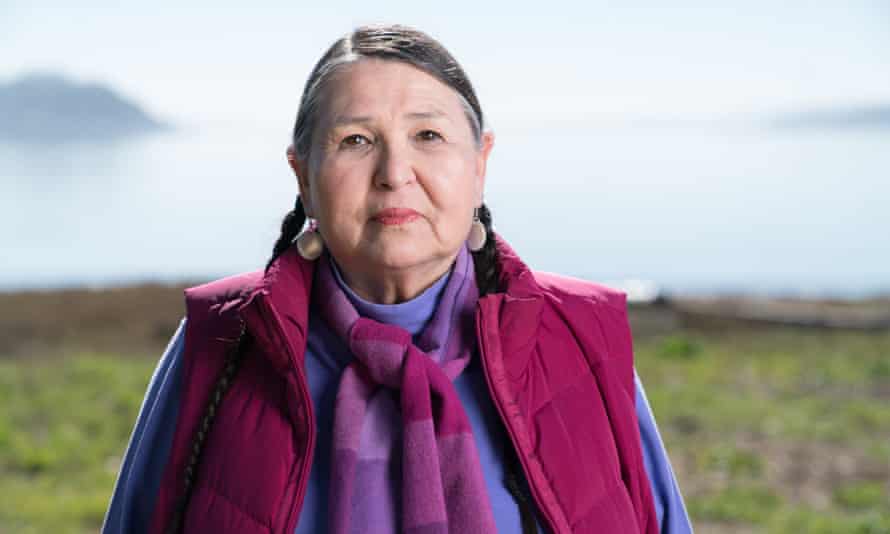
A few years later, when she was 29, Littlefeather's lungs collapsed – a consequence of her childhood tuberculosis – and she became very sick. She establish taking a holistic arroyo to her health helped and did a degree in holistic health and nutrition. She became a health consultant to Native American communities across the land, combining her noesis with traditional medicine. She likewise reconnected with the Catholic faith, working with Mother Teresa caring for Aids patients in hospices, and led the San Francisco Kateri Circumvolve, a Catholic group named after Kateri Tekakwitha, the offset Native American saint. Their religious practise is a synthesis of both traditions, she explains. "For example, we have our buffalo dances in the heart of the mass." It has helped her resolve her identity. "This is how I saved my life, by blending the 2 together. The acceptance of my dominant culture's ways and my Indian ways together, living peacefully side by side."
At present she is 1 of the elders transmitting knowledge down generations. Littlefeather gestures behind her to the sofa, where she mentors young Native American people. This is the real fulfilment in her life, she says. "When I go to the spirit earth, I'chiliad going to take all these stories with me. Simply hopefully I can share some of these things while I'thousand here." Littlefeather talks about the end of life with the same composure and dignity she exhibited that night in 1973. "I'm going to another place," she says. "I'thou going to the world of my ancestors. I'k proverb cheerio to you … I've earned the right to exist my true self."
chavezpatents1957.blogspot.com
Source: https://www.theguardian.com/us-news/2021/jun/03/i-promised-brando-i-would-not-touch-his-oscar-secret-life-sacheen-littlefeather
0 Response to "Marlon Brando Sent Someone to Oscars to Read a Statement for Him"
Post a Comment